For years, security has fought a branding problem.
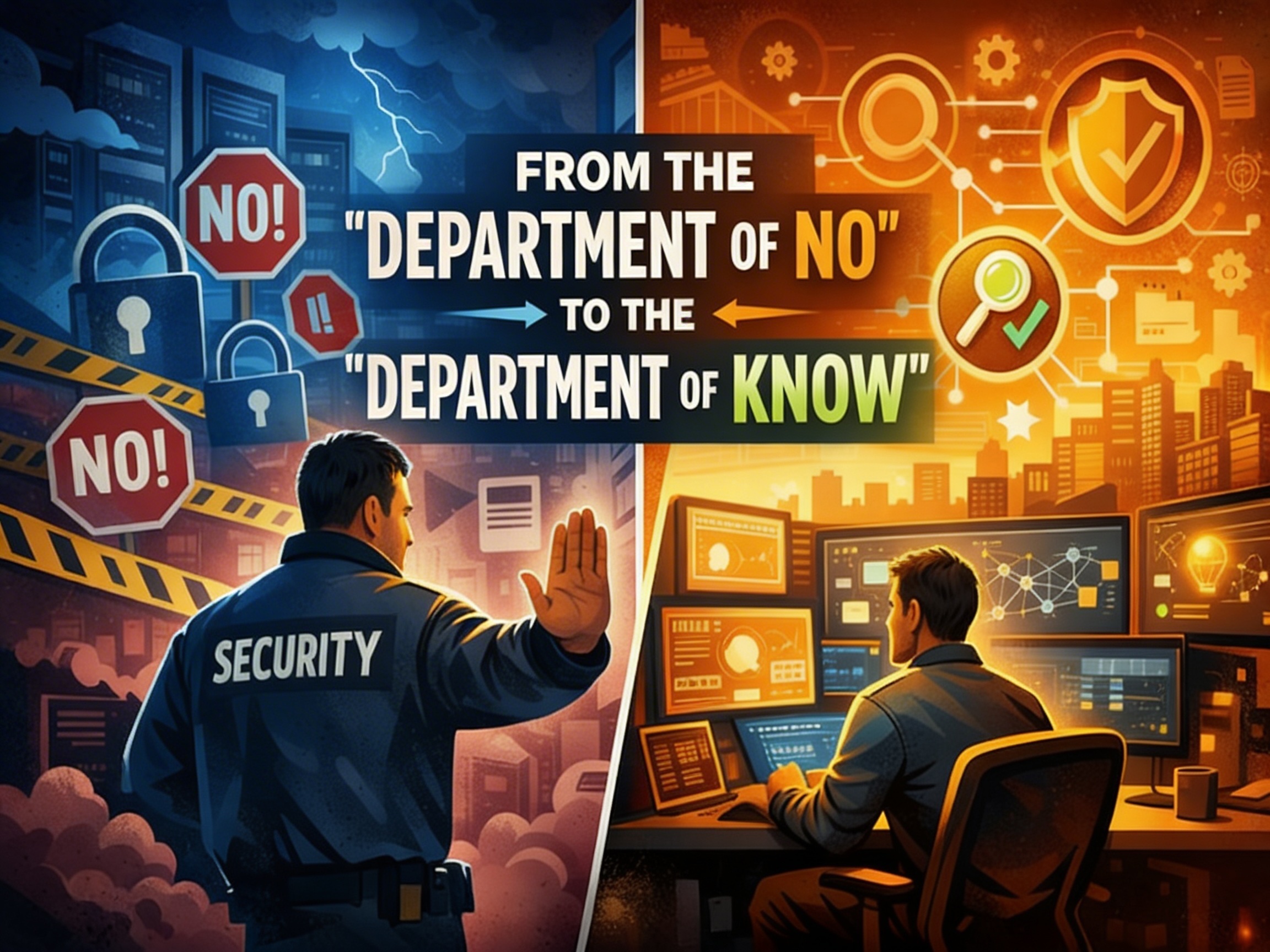
We became the “Department of No” because we often only show up at the moment of risk:
“No, you can’t ship that.”
“No, you can’t expose that service.”
“No, you can’t use that SaaS.”
Meanwhile, IT became its mirror image:
“No, you can’t lock that down, it will break performance.”
“No, you can’t patch it this week, it will disrupt operations.”
Most of that friction is not because either team is unreasonable.
It is because neither side has enough shared, real-time knowledge about the digital terrain when decisions are made.
And that is why the next shift in security is not about more alerts, more dashboards, or more tools. It is about deeper, adaptive, and contextualized knowledge.
Modern enterprises already have plenty of telemetry: vulnerability scanners, CNAPP, EDR, SIEM, IAM, asset inventories, ticketing systems, CMDBs, cloud logs, threat intelligence, and more.
Yet breaches keep reminding us of an uncomfortable truth: attackers win disproportionately through the simplest openings, especially unaddressed exposures. Verizon’s 2025 DBIR shows exploitation of vulnerabilities surged by 34%. Mandiant’s M-Trends 2025 report reinforces this trend, with exploits remaining the most frequently observed initial infection vector.
So despite more tools, more visibility, and more alerts, why are security teams still falling behind?
Because knowing “a vulnerability exists” is not the same as knowing:
• Where we are truly exposed right now
• What is business-critical in this environment
• What the real blast radius is if it is exploited
• Who can fix it, how, and with what operational tradeoffs
Without that shared understanding, security defaults to blunt prevention (“no”), and IT defaults to blunt stability (“no”).
Everyone is rational. Everyone is blocked.
From Vulnerability Management to Context-Driven Exposure Management
This is where context-driven exposure management, leveraging agentic AI aligned with the CTEM mindset, becomes transformative.
Gartner describes Continuous Threat Exposure Management (CTEM) as a systemic approach to continuously evaluate accessibility, exposure, and exploitability, and to align remediation with business impact and threat likelihood.
The most important word here is not just “continuous.” It is also “evaluation.”
In other words: autonomously converting fragmented signals into living, operational knowledge.
Think of it as moving from static lists of issues to a continuously updated map of your organization’s attack surface, dependencies, and real risk pathways.
This shift is increasingly powered by agentic systems that continuously observe environments, connect fragmented context, and translate exposure into prioritized action faster than humans ever could.
1) Know your digital terrain (not just your inventory)
An inventory tells you what exists.
Terrain knowledge tells you how the environment behaves:
• Which assets are internet-facing vs internally reachable
• Which identities can reach what
• Which workloads, applications, and services are interconnected
• Which third-party integrations create hidden exposure paths
• Which controls are real in practice vs assumed on paper
This matters because “critical” on a CVSS score is not the same as “critical” on your terrain.
Agentic exposure management relies on systems that continuously reconcile these relationships as environments change, rather than relying on static human-maintained diagrams and systems of record.
2) Know what matters most (to the business)
Context allows exposures to be ranked by true business impact:
• Systems that support revenue, safety, regulated data, or privileged access
• Crown jewel applications vs low-consequence tooling
• Exposures that are theoretically scary vs practically exploitable
When prioritization becomes credible, defensible, and explainable, security stops arguing from fear and starts operating from evidence.
3) Know where your underbelly is right now
Your risk posture is not static:
• New deployments change reachability
• Cloud drift opens new paths
• Integrations expand privilege chains
• New exploits reshape threat relevance overnight
Exposure is a moving condition. Agentic exposure management treats it as such, continuously reassessing what attackers can realistically reach at any given moment.
This kind of real-time posture simply cannot be maintained through periodic human review. It requires agentic systems that continuously observe, correlate, and re-evaluate exposure as environments evolve.
4) Know exactly what to fix and who will fix it
This is where “Department of Know” becomes “Department of Yes.”
Instead of:
“Please patch 10,000 findings.”
The output becomes:
• “These 7 exposures create the shortest path to the billing system.”
• “Here is the precise attack chain that makes it exploitable.”
• “Here are three remediation options, with risk reduction and operational tradeoffs.”
• “Here is the owner, workflow, and evidence needed to close each gap.”
Security stops asking for blanket lockdowns.
IT gets targeted, minimal, high-impact fixes.
The business moves faster, not slower.
The cultural shift that follows the technical shift
When security can consistently answer:
• What matters most
• What is truly exposed right now
• What happens if it is exploited
• What to fix first
• Who owns each fix
• How to reduce risk quickly with minimal disruption
Security stops being a blocker and becomes a strategic enabler.
Not a “Department of No.”
Not an unrealistic “Department of Yes.”
But a Department of Know.
One that earns the right to say yes because it understands the terrain, the risk, and the path to reduction with precision. And in a world where exploitation dominates breach entry points, that level of knowledge is no longer optional.
It is the operating system of modern security.

Sharon has over 25 years of experience in cyber, intelligence, and operations. He began in Israel’s elite military intelligence units, where he served as COO of the Intelligence Analysis Division, and later as CISO and Chief Intelligence Officer of the Home Front Command. After that, Sharon led biz dev and delivery at Sygnia, a top-tier incident response and cybersecurity consulting firm. During this time, he identified a critical unmet need across the industry. That realization led to the founding of Tonic, which sits right at the intersection of cyber, data, and AI.